
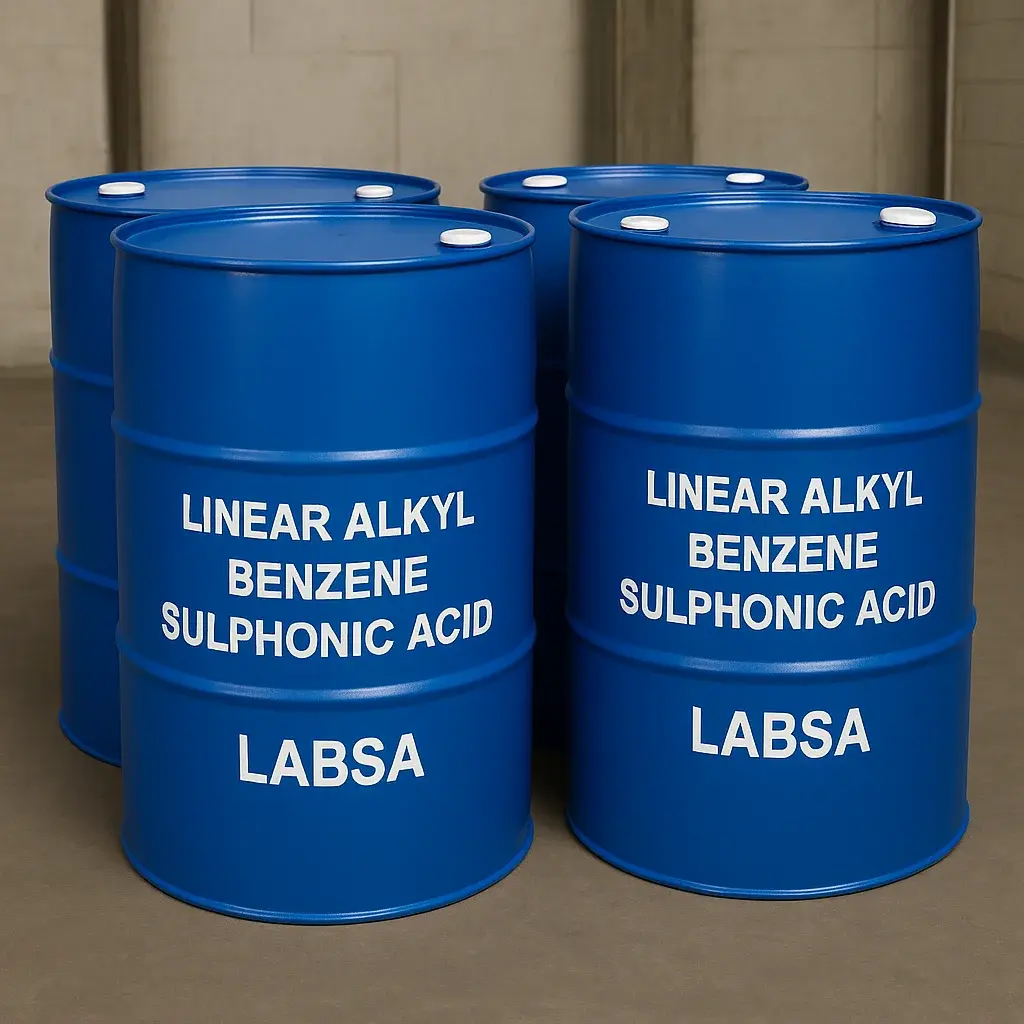
LABSA (Linear Alkylbenzene Sulfonic Acid)
Manufacturer & Export Supplier
Core anionic surfactant raw material for detergent manufacturing. LABSA 96% from Thailand — the #1 ingredient in powder and liquid detergents worldwide.
Available Grades
Packaging Options
Product Overview
LABSA (Linear Alkylbenzene Sulfonic Acid) is the world's most widely used anionic surfactant and the primary raw material for powder and liquid detergent production. Dusit Chemicals exports LABSA 96% from Thailand to detergent manufacturers in 40+ countries — primarily Nigeria, Ghana, Ivory Coast, Senegal, Kenya, Indonesia, Vietnam, the Philippines and the Middle East. Our LABSA delivers 96-97% active matter content, excellent foam generation, strong cleaning performance, and full biodegradability under OECD 301 standards. As a LABSA supplier in Thailand supplying the Philippines and Southeast Asia, Dusit Chemicals sources Linear Alkylbenzene (LAB) from petrochemical plants in Southeast Asia and sulfonates it to produce LABSA 96% that meets global detergent formulation standards. Philippine detergent manufacturers import LABSA from Thailand under the ASEAN Free Trade Area (AFTA) 0% duty scheme, making Thailand one of the most cost-competitive LABSA supplier sources for the Philippines market. Thailand's strategic port infrastructure (Laem Chabang, Bangkok Port) allows us to ship 20ft and 40ft containers to Manila, Cebu, and Davao ports in 3–5 days ocean transit — among the fastest LABSA delivery timelines in the region. For Philippine buyers, Dusit Chemicals is a trusted LABSA supplier offering LABSA 96% in 200kg drums and 1,000kg IBCs, with standard export documentation (COA, SDS, Halal cert, phytosanitary) and LC or TT payment terms. Our LABSA to Philippines is exported under HS code 3402.11 at 0% ASEAN duty, giving Philippine detergent producers a landed cost advantage versus non-ASEAN sources. Minimum order: 1 × 20ft container (80 drums / 16 MT or 20 IBCs / 20 MT). LABSA is used at 15–30% loading in powder detergent formulations and 10–20% in liquid detergents. When neutralized with NaOH, it forms LAS (sodium linear alkylbenzene sulfonate) — the active cleaning agent responsible for surfactancy, emulsification, and foaming in finished detergent products. Compared to SLES (Sodium Lauryl Ether Sulfate), LABSA is lower cost, produces higher foam, and is the preferred choice for price-sensitive markets in Africa, South Asia, and ASEAN. SLES is gentler (lower irritation) and preferred in premium personal care formulations. Dusit Chemicals offers flexible supply terms: spot orders, quarterly contracts, and annual supply agreements with price hedging. We accept payment via LC (Letter of Credit), TT (Telegraphic Transfer), and Usance LC for established customers. All shipments include Certificate of Analysis (CoA), Safety Data Sheet (SDS/MSDS), Halal certificate (CICOT Thailand), and full BL/packing documentation. As a leading LABSA supplier Philippines buyers rely on, Dusit Chemicals ships LABSA 96% directly from Thailand to all major Philippine ports — Manila (South Harbor / Manila International Container Terminal), Cebu (Cebu International Port), and Davao (Sasa Port) — in 3–5 days ocean transit. Philippine detergent manufacturers in Metro Manila, Cebu City, and Davao City import LABSA under the ASEAN Free Trade Area (AFTA) agreement at 0% import duty, making Thailand-origin LABSA the most cost-competitive source for the Philippines market. The Philippines has a growing domestic detergent manufacturing sector — from large players to regional powder and liquid detergent producers — all requiring a reliable LABSA supplier Philippines-bound with consistent 96% active matter. To order LABSA as a Philippine buyer: contact Dusit Chemicals for a proforma invoice, arrange a 20ft FCL (80 drums × 200 kg = 16 MT or 20 IBCs × 1,000 kg = 20 MT), and ship under HS code 3402.11 at 0% AFTA duty. Transit from Laem Chabang to Manila is typically 3–4 days; to Cebu or Davao 4–5 days. We provide full export documentation including COA, SDS, Halal certificate, Bill of Lading, and Certificate of Origin (Form D) for AFTA duty exemption. ## LABSA Manufacturers in Saudi Arabia — Import LABSA 96% from Thailand Saudi Arabia's detergent manufacturing sector is one of the Gulf's largest, with major producers including SABIC-linked chemical converters, Al-Amoudi Group factories, and a growing base of SME detergent blenders across Riyadh, Jeddah, and Dammam supplying household brands throughout the GCC. Despite Saudi Arabia's strong petrochemical base, domestic LABSA production capacity remains limited relative to the country's detergent consumption — creating significant import demand, particularly for LABSA 96% from ASEAN origins. Why do LABSA manufacturers in Saudi Arabia import from Thailand? Thai-origin LABSA 96% typically lands in Jeddah Islamic Port or King Abdulaziz Port (Dammam) at $1,350–$1,550/MT (CIF), compared to spot market prices from European or US-origin suppliers at $1,600–$1,900/MT. The ASEAN-Gulf sea route via Colombo or Port Klang transshipment delivers containers in 14–18 days from Laem Chabang — competitive with any other global origin. Saudi detergent manufacturers benefit from Dusit Chemicals' Halal certification (CICOT Thailand), which satisfies Saudi Standards, Metrology and Quality Organization (SASO) import requirements and eases customs clearance through the Saudi Food and Drug Authority (SFDA) for detergent raw materials. Import logistics for Saudi buyers: LABSA is classified under HS code 3402.11 for Saudi customs. A standard 20ft container carries 80 × 200 kg drums (16 MT) or 20 × 1,000 kg IBCs (20 MT). Required documentation for Saudi customs clearance includes: commercial invoice (in Arabic and English), packing list, Certificate of Analysis (CoA), Safety Data Sheet (GHS-compliant), Halal certificate, Bill of Lading, and a Certificate of Origin. Saudi importers should also obtain pre-approval from SASO for new chemical raw material imports. GCC common external tariff on LABSA (HS 3402.11) is 5% — factor this into landed cost calculations alongside ocean freight and port handling charges at Jeddah or Dammam. For Saudi detergent manufacturers sourcing LABSA, Dusit Chemicals offers quarterly price contracts with LAB-feedstock-linked price adjustment clauses, protecting buyers from crude oil volatility. LC at sight and 30/60-day Usance LC payment terms are accepted through Saudi and international banks. Request a proforma invoice and current CIF Jeddah price sheet by contacting our export team.
LABSA Manufacturers in Saudi Arabia — Why Saudi Detergent Factories Import LABSA 96% from Thailand
Saudi Arabia's detergent manufacturing sector — centred in Riyadh, Jeddah, and Dammam — ranks among the Gulf's largest, yet domestic LABSA production capacity is insufficient to meet demand. Saudi detergent producers therefore rely heavily on LABSA imports, making "LABSA manufacturers in Saudi Arabia" one of the most searched supply-chain queries in the GCC chemicals sector. Thai-origin LABSA 96% from Dusit Chemicals fills this gap competitively: CIF Jeddah pricing lands at $1,350–$1,550/MT — 10–20% below equivalent European-origin LABSA — with ocean transit of 14–18 days from Laem Chabang via Colombo or Port Klang transshipment. Why Saudi buyers choose Thai LABSA over domestic or regional alternatives: (1) Halal certification (CICOT Thailand) — mandatory for SASO import compliance and for detergent brands sold in Saudi retail channels; (2) GHS-compliant Safety Data Sheet in Arabic/English — required by Saudi Food and Drug Authority (SFDA) for chemical raw material import clearance; (3) Competitive CIF Jeddah pricing vs European or US origins; (4) Full IMDG DG documentation (UN3265, Class 8, PG III) for hassle-free customs clearance at Jeddah Islamic Port or King Abdulaziz Port, Dammam. Import logistics for Saudi Arabia: LABSA is classified under HS code 3402.11 with a 5% GCC common external tariff. A standard 20ft container carries 80 × 200 kg drums (16 MT) or 20 × 1,000 kg IBCs (20 MT). Documentation for Saudi customs: commercial invoice (in Arabic and English), packing list, Certificate of Analysis, Safety Data Sheet (GHS-compliant), Halal certificate, Bill of Lading, and Certificate of Origin. Contact our export team for a CIF Jeddah or Dammam proforma invoice.
LABSA Supplier Philippines — Import LABSA 96% from Thailand at 0% ASEAN Duty
Dusit Chemicals is the preferred LABSA supplier for Philippines detergent manufacturers. Philippine buyers import LABSA from Thailand under the ASEAN Free Trade Area (AFTA) at 0% import duty (HS code 3402.11), making Thai-origin LABSA significantly more cost-competitive than European or non-ASEAN sources. We ship LABSA 96% from Bangkok/Laem Chabang to Manila, Cebu, and Davao in 3–5 days ocean transit — the fastest LABSA delivery timeline from any supplier. Available in 200kg drums and 1,000kg IBCs with Halal certification (CICOT Thailand), Certificate of Analysis, and complete BL documentation. MOQ: 1 × 20ft container (16–20 MT). As a LABSA supplier in Philippines-facing export, we offer standard export terms: 30% TT advance + 70% against BL copy for new customers, Usance LC for established relationships. Shipping LABSA from Thailand to the Philippines typically takes 3–4 days to Manila and 4–5 days to Cebu or Davao; imports clear under HS code 3402.11 at 0% AFTA duty with a Form D Certificate of Origin.
LABSA (Linear Alkylbenzene Sulphonic Acid) Supplier Thailand
Dusit Chemicals is a leading LABSA supplier in Thailand, manufacturing and exporting Linear Alkylbenzene Sulphonic Acid (LABSA 96%) to detergent manufacturers, formulators, and industrial cleaning product producers in over 40 countries. LABSA — also written as Linear Alkylbenzene Sulfonic Acid, LAS acid, or sulphonic acid — is the most important anionic surfactant in global detergent manufacturing, used as the primary active ingredient in powder laundry detergents, liquid detergents, dishwashing liquids, and industrial cleaners. As a Thailand-based LABSA manufacturer, Dusit Chemicals benefits from strategic location at Laem Chabang and Bangkok ports — enabling fast ocean transit to all ASEAN markets (3–6 days), South Asia (8–12 days), the Middle East (10–15 days), and Africa (18–25 days). ASEAN buyers import LABSA from Thailand at 0% import duty under the ASEAN Free Trade Area (AFTA) with our Form D Certificate of Origin — a significant landed-cost advantage versus non-ASEAN sources such as Europe or China. Our LABSA 96% specification: active matter 96–97% (ASTM D1681 / ISO 2871), free sulfuric acid ≤1.5%, color (Klett) ≤80, moisture ≤0.5%, unsulfonated matter ≤2.0%, pH (1% solution) 1.0–2.0. Available in 200 kg HDPE drums and 1,000 kg IBC totes. Minimum order quantity (MOQ): 1 × 20ft container (80 drums = 16 MT drums, or 20 IBCs = 20 MT IBC). Sample orders of 2–5 kg available before full container commitment. Packaging and export: LABSA 96% ships as a dangerous good (UN3265, Class 8 Corrosive, PG III) in UN-approved sealed drums or IBCs. Dusit Chemicals handles all IMDG DG documentation — DG declaration, UN packaging certificate, hazard labels, and emergency response documentation. Full export pack included with every shipment: Certificate of Analysis (CoA), Safety Data Sheet (SDS/MSDS, GHS-compliant), Halal Certificate (CICOT Thailand), Certificate of Origin (Form D for ASEAN), and Commercial Invoice/Packing List/Bill of Lading. LABSA is neutralized with sodium hydroxide (NaOH) by the detergent manufacturer to produce LAS (Linear Alkylbenzene Sulfonate) — the actual cleaning surfactant. At 96% active matter, LABSA 96% delivers the highest cleaning power per kilogram of raw material, making it the preferred grade for cost-conscious detergent manufacturers in Africa, Southeast Asia, and South Asia. Current FOB Bangkok pricing: $1,250–$1,450/MT. Contact our export team for a current price sheet and pro-forma invoice within 4 business hours.
LABSA vs SLES: Key Differences for Detergent Manufacturers
Choosing between LABSA and SLES is one of the most important formulation decisions in detergent manufacturing. LABSA (Linear Alkylbenzene Sulfonic Acid) is lower cost ($1,250–$1,450/MT), produces high foam, and is used at 15–30% in powder and liquid detergents as the primary surfactant — the workhorse of global detergent formulation, particularly for price-sensitive markets in Africa, South Asia, and ASEAN. SLES (Sodium Lauryl Ether Sulfate) is milder, ethoxylated (EO groups reduce skin irritation), and preferred in shampoos, body washes, and premium hand soaps at $1,600–$2,000/MT. Most high-volume detergent formulations combine both: LABSA at 15–25% for cleaning performance and cost efficiency, SLES at 5–10% for mildness and foam stability. For commodity powder detergents (Africa, Southeast Asia): LABSA dominates. For premium liquid personal care: SLES or SLES+CAPB blend is standard. Dusit Chemicals supplies both LABSA 96% and SLES 70% from Thailand — contact us for formulation guidance and combined pricing.
LABSA Supplier Thailand — LABSA 96% Export to 40+ Countries
As a leading LABSA supplier Thailand, Dusit Chemicals exports LABSA 96% (Linear Alkylbenzene Sulfonic Acid) to detergent manufacturers in Nigeria, Ghana, Kenya, Indonesia, Vietnam, the Philippines and the Middle East. Our LABSA 96% is the benchmark anionic surfactant for powder and liquid detergent formulation — shipped FOB Bangkok in 200kg drums and 1,000kg IBCs with Halal certification, CoA, and SDS included. We are a trusted LABSA manufacturer and exporter serving 40+ countries with competitive pricing from $1,250/MT. LABSA manufacturers and LABSA distributors worldwide choose Dusit Chemicals for consistent active matter (96–97%), reliable supply, and complete export documentation.
LABSA Technical Specifications & Quality Standards
LABSA 96% (Linear Alkylbenzene Sulfonic Acid) from Dusit Chemicals meets the following technical standards used by global detergent manufacturers: Active Matter Content: 96–97% (ASTM D1681 / ISO 2871 method); Free Sulfuric Acid: ≤1.5% (titration method); Color (Klett): ≤80 (Klett-Summerson colorimeter at 420 nm); Moisture: ≤0.5% (Karl Fischer or oven method); Unsulfonated Matter: ≤2.0%; pH (1% solution, 25°C): 1.0–2.0 (strong acid, requires neutralization). Our LABSA is manufactured from LAB (Linear Alkylbenzene) with carbon chain length C10–C13 (predominantly C12), which gives the optimal balance of detergency, biodegradability, and formulation stability. The sulfonation process uses SO₃ (sulfur trioxide) gas-phase sulfonation in a falling film reactor — the industry-standard method that produces uniform sulfonation and minimal by-products. Each production batch is tested against these parameters before release, and a Certificate of Analysis (CoA) is provided with every shipment. For buyers in Nigeria, Indonesia, Vietnam, and the Middle East who require specific batch testing, we can arrange third-party SGS or Bureau Veritas testing at origin before shipment.
LABSA Applications in Detergent Manufacturing: Formulation Guide
LABSA (Linear Alkylbenzene Sulfonic Acid) is the foundation of modern detergent chemistry. Here is how leading detergent manufacturers use LABSA across different product categories: (1) Powder Laundry Detergent: LABSA 96% is neutralized with sodium hydroxide (NaOH) to form LAS (Linear Alkylbenzene Sulfonate), which is spray-dried with STPP (sodium tripolyphosphate), sodium sulfate, sodium carbonate, zeolite, enzymes (protease, amylase), optical brighteners, and fragrance to produce powder detergent. Typical LABSA loading: 15–25% (pre-neutralization weight basis). Market-leading powder detergent brands in Africa and Asia rely on LABSA as the primary surfactant for cost-effectiveness and cleaning performance. (2) Liquid Detergent & Dishwashing Liquid: LABSA is neutralized in-situ with NaOH solution to produce LAS, then blended with SLES 70% (5–10%), cocamidopropyl betaine (CAPB, 2–5% for mildness), sodium chloride (viscosity adjustment), water, fragrances, and preservatives. Total active matter in a finished liquid detergent: 25–40%. (3) Industrial & Institutional Cleaners (I&I): Higher LABSA concentrations (20–35%) are used in heavy-duty floor cleaners, degreasers, and vehicle wash products, often combined with nonionic surfactants like alcohol ethoxylates for soil suspension at elevated temperatures. (4) Textile Scouring Agents: LABSA-based formulations are used to remove sizing, oils, and waxes from grey fabric before dyeing. The anionic character of LAS is compatible with most reactive and vat dyes. (5) Car Wash Concentrates: LABSA provides the high-foaming, fast-rinsing character required for vehicle wash products, typically formulated at 10–15% active matter in dilutable concentrates.
LABSA Import & Export: Logistics, Duties, and Documentation
Importing LABSA 96% from Thailand involves understanding logistics routes, duty structures, and documentation requirements. Dusit Chemicals handles all export documentation from our Bangkok warehouse: Commercial Invoice (CIF/FOB as agreed), Packing List, Bill of Lading (BL or Seaway BL), Certificate of Origin (Form D for ASEAN, general CO for other markets), Certificate of Analysis (CoA) per batch, Safety Data Sheet (SDS/MSDS, GHS-compliant), Halal Certificate (CICOT Thailand — issued per shipment), and Phytosanitary Certificate where required by the importing country. LABSA is classified as a dangerous goods shipment under IMDG Code: UN3265, Class 8 (Corrosive Liquid, Acidic, Organic, NOS), Packing Group III. Ocean freight shipping requires proper DG declaration and Bill of Lading endorsement. Key trade data: LABSA HS Code: 3402.11 (sulfonated products) or 2904.20 (sulfonated derivatives of hydrocarbons) — classification varies by importing country customs authority. Incoterms: We offer FOB Bangkok (most common for LABSA), CIF to named destination port, and CFR. Lead time from order confirmation to vessel departure: 5–10 working days for in-stock grades; 15–21 days for large contract quantities. For buyers in Indonesia, Vietnam, Malaysia, Thailand, Philippines, Singapore, and Myanmar under ASEAN, LABSA from Thailand qualifies for AFTA 0% duty with Form D Certificate of Origin.
LABSA Price Trend 2026 — Market Analysis, Price Drivers, and Buying Strategy
LABSA price trend in 2026: LABSA 96% FOB Bangkok pricing ranges from $1,250–$1,450/MT, with the LABSA price trend driven primarily by crude oil feedstock costs (LAB — Linear Alkylbenzene tracks benzene and n-paraffin prices), order volume, and contract structure. Understanding the LABSA price trend helps detergent manufacturers time procurement and secure the best landed cost. Spot pricing for 1–5 MT LCL shipments sits at $1,400–$1,450/MT in drums; full 20ft container (16–20 MT) pricing is $1,250–$1,350/MT. Annual contract pricing with quarterly price adjustment clauses is available for buyers taking 100+ MT per year and typically offers savings of $50–$100/MT versus spot. LABSA price trend analysis — key price drivers in 2026: (1) Crude oil and benzene prices — LABSA price trend tracks global benzene spot with a 4–6 week lag due to LAB production lead time. When Brent crude rises above $85/barrel, expect the LABSA price trend to push above $1,400/MT within 6 weeks. (2) Sulphur and SO₃ availability — sulfonation requires sulphur trioxide (SO₃); supply tightness in Asian markets periodically pushes LABSA production costs up. (3) Shipping and container rates — ocean freight from Bangkok to West Africa (the largest LABSA import region) fluctuates with Red Sea shipping disruptions and global container availability. (4) Seasonal demand — Q1 (January–March) typically sees lower demand and slightly better pricing; Q3 (July–September) sees peak demand from African markets ahead of the dry season. LABSA price 2026 — historical context and forecast: The LABSA price 2026 FOB Bangkok average is approximately $1,320/MT for full container loads, compared to $1,280/MT in 2025 and $1,420/MT in 2024 when benzene prices peaked. The LABSA price trend in 2026 is broadly stable-to-softening as crude oil stabilizes and Chinese LAB production capacity expands. Buyers tracking the LABSA price trend should register for our monthly LABSA price alert newsletter — contact our export team. Buying strategy based on LABSA price trend: For annual requirements above 200 MT, consider split purchasing — 40% annual contract at fixed LABSA price 2026 rate, 60% spot to capture dips. For smaller buyers (12–50 MT/year), quarterly orders of one 20ft container each timed to market dips (typically March–April and September–October) give the best landed cost. Dusit Chemicals offers a LABSA price alert service — register your email to receive monthly LABSA price trend updates and advance notice of price adjustments. Contact our export team for a personalized LABSA procurement strategy based on your country, volume, and formulation requirements.
Why Source LABSA from Thailand — 5 Competitive Advantages for Detergent Manufacturers
Thailand is the most strategic source for LABSA (Linear Alkylbenzene Sulfonic Acid) for manufacturers in Southeast Asia, Africa, and South Asia. Here are five key reasons global detergent manufacturers choose a Thailand LABSA supplier like Dusit Chemicals over alternatives from China, India, or Europe: (1) ASEAN Free Trade Area (AFTA) Zero-Duty Access — Thailand-origin LABSA (HS code 3402.11) qualifies for 0% import duty for all ASEAN member state buyers (Indonesia, Vietnam, Philippines, Malaysia, Myanmar, Cambodia, Laos) under AFTA with Form D Certificate of Origin. This saves 5–15% on landed cost compared to non-ASEAN sources. (2) Fast Ocean Transit — Laem Chabang and Bangkok ports offer direct container services with some of the shortest transit times in Asia: Philippines 3–5 days, Indonesia 4–6 days, Vietnam 3–4 days, Malaysia 2–3 days, India 8–12 days, Nigeria 18–22 days. Faster transit means lower working capital tied up in pipeline stock. (3) Halal Certification (CICOT) — Dusit Chemicals LABSA 96% carries Halal certification from CICOT Thailand (Central Islamic Council of Thailand) — mandatory for detergent manufacturers supplying Muslim-majority markets (Indonesia, Malaysia, Bangladesh, Nigeria, Middle East). Certificate provided with every shipment. (4) Complete DG Documentation — LABSA is UN3265, Class 8 Corrosive liquid. Dusit Chemicals handles all IMDG dangerous goods documentation: DG declaration, UN packaging certificate, hazard labels, and emergency response documentation. We work with certified DG freight forwarders on all major trade routes. (5) Consistent Active Matter Quality — Our LABSA 96% consistently tests at 96.0–97.0% active matter per batch, verified by ASTM D1681/ISO 2871 titration method. We provide batch-specific Certificates of Analysis and can arrange SGS or Bureau Veritas third-party inspection before loading for buyers who require it.
LABSA FAQs: Technical Data for Detergent Formulators
Technical questions about LABSA 96% answered for detergent manufacturers: Q: What is the sulfonation process for LABSA? A: Dusit Chemicals' LABSA is produced using SO₃ (sulfur trioxide) gas-phase sulfonation in a falling film reactor — the industry-standard method that ensures uniform sulfonation of Linear Alkylbenzene (LAB) feedstock with minimal di-sulfonate and unsulfonated by-products. The LAB feedstock uses C10–C13 alkyl chains (predominantly C12), which delivers optimal HLB balance for detergent applications. Q: What is the neutralization ratio of LABSA 96% to NaOH? A: To neutralize LABSA 96% to LAS (sodium salt), you need approximately 0.135–0.140 kg of NaOH (100% basis) per kg of LABSA 96%. Using 50% NaOH solution: approximately 0.270–0.280 kg of solution per kg of LABSA. Target pH for the neutralized LAS slurry: 7.0–8.5. Q: How much LABSA do I need per ton of finished powder detergent? A: A typical medium-duty powder detergent with 15% active matter requires approximately 156 kg of LABSA 96% per MT of finished product (assuming complete neutralization to LAS). A premium heavy-duty formulation at 25% active matter requires approximately 260 kg LABSA per MT finished product. Q: Can LABSA be stored in stainless steel tanks? A: Yes — LABSA is stored in HDPE-lined or stainless steel (316L) tanks at ambient temperature. Avoid carbon steel (corrosion risk) and aluminum (reacts with strong acid). Shelf life in sealed original packaging: 12 months from production date.
LABSA Manufacturers in Saudi Arabia — Import LABSA 96% Direct from Thailand
Saudi Arabia has one of the Gulf Cooperation Council's largest detergent manufacturing sectors, with major producers concentrated across Riyadh, Jeddah, and Dammam producing household cleaning brands distributed throughout the GCC. Despite Saudi Arabia's strong petrochemical base (SABIC and derivatives), domestic LABSA production capacity falls significantly short of the country's detergent manufacturing demand — creating substantial sustained import requirements, predominantly from ASEAN-origin suppliers including Thailand. Dusit Chemicals is a direct LABSA supplier to Saudi detergent manufacturers. We export LABSA 96% (CAS 27176-87-0) to Saudi Arabia CIF Jeddah Islamic Port and CIF King Abdulaziz Port (Dammam). Typical CIF Jeddah pricing for Thai-origin LABSA: $1,350–$1,550/MT, versus European or US-origin LABSA at $1,600–$1,900/MT — a 10–25% landed cost advantage. Ocean transit from Laem Chabang port (Thailand) to Jeddah: 14–18 days via Colombo or Port Klang transshipment; to Dammam: 16–20 days. Saudi customs and documentation requirements for LABSA import: HS code 3402.11 (Saudi Customs tariff). GCC common external tariff: 5%. Required documents: Commercial Invoice (in Arabic and English), Packing List, Certificate of Analysis (CoA) with active matter and specification data, Safety Data Sheet (GHS-compliant Arabic version available), Halal Certificate (CICOT Thailand — satisfies SASO requirements), Bill of Lading, Certificate of Origin. SASO pre-approval for new chemical raw material imports may be required for first-time importers — consult your Saudi customs broker. Why Saudi detergent manufacturers choose Thai LABSA from Dusit Chemicals: (1) CICOT Halal certification — satisfying SASO's documentation requirements for chemical raw materials; (2) Competitive CIF Jeddah/Dammam pricing 10–25% below European or US-origin LABSA; (3) Consistent 96–97% active matter — meeting the ASTM D1681/ISO 2871 specification for detergent-grade LABSA; (4) Quarterly price contracts with LAB feedstock price adjustment clauses available — protecting Saudi buyers from crude oil volatility; (5) LC at sight and 30/60-day Usance LC terms accepted through Saudi and international correspondent banks. Contact our export team for a current CIF Jeddah proforma invoice and specification sheet.
Buy LABSA Chemical Direct from Thailand — Detergent Grade Surfactant for Manufacturers
Dusit Chemicals makes it straightforward to buy LABSA chemical direct from Thailand as a B2B buyer. Whether you are a detergent manufacturer in Nigeria buying your first container, a Vietnamese formulator expanding production, or an Indonesian distributor looking for a consistent supplier, here is the complete process for purchasing LABSA 96% from Dusit Chemicals: Step 1 — Inquiry: Contact our export team with your required quantity (MT or containers), preferred packaging (200kg drums or 1,000kg IBCs), destination port, and preferred Incoterms (FOB, CIF, CFR). We respond within 4 business hours with a current price quotation valid for 5 working days. Step 2 — Pro-forma Invoice: Once you confirm quantity and price, we issue a Pro-forma Invoice (PI) with full product specs, packaging details, unit price, total value, payment terms, and estimated shipment date. The PI includes our LABSA Certificate of Analysis (CoA) for your technical review. Step 3 — Payment: Standard payment terms for new buyers: 30% TT advance + 70% TT against copy of Bill of Lading. For established buyers with good payment history: LC at sight, Usance LC (30/60/90 days), or 100% TT against documents. For buyers in Nigeria, Ghana, and other African markets — we work with major correspondent banks and can advise on the fastest LC-clearing banks for your country. Step 4 — Production and Quality Control: LABSA 96% is produced and held in our Bangkok warehouse. Each batch undergoes QC testing: active matter (titration), free acid, color (Klett), and moisture before dispatch. Certificate of Analysis (CoA) is issued per batch number. Step 5 — Shipping and Documentation: Dangerous goods (UN3265, Class 8) freight booking with a certified DG carrier. Full documentation pack: Commercial Invoice, Packing List, Bill of Lading, Certificate of Origin (Form D for ASEAN buyers), CoA, SDS (GHS-compliant), Halal Certificate (CICOT), and customs value declaration. Step 6 — Delivery: Ocean transit times from Bangkok/Laem Chabang: Philippines 3–5 days; Indonesia 4–6 days; Vietnam 3–4 days; India 8–12 days; Nigeria 18–22 days; Ghana 20–24 days; Kenya 14–18 days; UAE 10–14 days. Reefer booking not required for LABSA (ambient temperature, sealed drums/IBCs). Why buy LABSA from Dusit Chemicals: Consistent 96–97% active matter, Halal certified (CICOT Thailand), over 12 years of LABSA export experience, available in 200kg drums and 1,000kg IBCs, competitive FOB pricing from $1,250/MT, and a dedicated export team fluent in English, Thai, and Chinese. First-time buyers are welcome — we provide sample kits (2 kg per sample) before your first container order. Contact us today for a current LABSA price and availability check.
LABSA and SLES — Combined Detergent Chemicals Supply from Thailand
LABSA and SLES are the two most important anionic surfactants in detergent and personal care manufacturing, and Dusit Chemicals supplies both from Thailand in one consolidated export shipment. LABSA and SLES detergent chemicals are typically used together: LABSA 96% provides high-performance, low-cost cleaning power as the primary surfactant in powder and liquid laundry detergents, while SLES 70% adds mildness, fine foam, and skin compatibility for liquid detergents, shampoos, and personal care products. Most industrial detergent formulations use both: LABSA at 15–25% loading for cleaning economy, SLES at 5–10% for foam stability and mildness upgrade. For body wash manufacturers, SLES 70% is used at 8–12% active matter as the primary body wash surfactant — see our <a href="/products/sles">SLES 70% body wash surfactant page</a> for complete formulation guidance at 8–12% active matter loading. Dusit Chemicals can co-load LABSA 96% drums and SLES 70% drums or IBCs in the same 20ft container — reducing freight cost and simplifying procurement. LABSA and SLES detergent chemicals from Thailand are exported at 0% ASEAN import duty under AFTA, making Thailand the most cost-competitive single-source origin for detergent manufacturers in Indonesia, Vietnam, the Philippines, Bangladesh, Nigeria, and the Middle East.
LABSA 96% Supplier to Dubai & the UAE — Import from Thailand via Jebel Ali
Dusit Chemicals is a LABSA 96% supplier serving Dubai and the wider UAE — Dubai, Sharjah, Ajman, Abu Dhabi and Fujairah — and the broader Gulf detergent and cleaning-products sector. UAE detergent and household-cleaning manufacturers import Thai LABSA for three reasons: competitive CIF Jebel Ali pricing, reliable ASEAN-origin supply, and consistent 96–97% active matter from a single export source. Verified LABSA 96% specification: active matter 96–97% (ASTM D1681 / ISO 2871), free sulfuric acid ≤1.5%, colour (Klett) ≤80, moisture ≤0.5%, unsulfonated matter ≤2.0%, pH (1% solution) 1.0–2.0, specific gravity 1.055–1.065, C10–C13 alkyl chain (predominantly C12), biodegradability >90% in 28 days (OECD 301B), CAS 85536-14-7, HS code 3402.11, classified UN3265 Class 8 (corrosive) Packing Group III. UAE / GCC import logistics: LABSA imports under HS 3402.11, with the GCC common external tariff of 5%. Packaging is 200 kg HDPE drums or 1000 kg IBC totes — a 20ft container holds 80 drums (16 MT) or 20 IBCs (20 MT). Ocean transit from Laem Chabang to Jebel Ali is approximately 10–14 days. Every shipment includes full IMDG dangerous-goods documentation, a batch-specific Certificate of Analysis (COA), GHS-compliant Safety Data Sheet (SDS), Halal Certificate (CICOT Thailand), and Form D / Certificate of Origin. Why Gulf buyers choose Dusit Chemicals: importer-direct Thai-origin LABSA with CICOT Halal certification, batch COA, transparent CIF Jebel Ali transit, and full IMDG handling — differentiators over UAE-local traders competing only on local stock. Contact our export team to request a CIF Jebel Ali proforma invoice and specification sheet for Dubai and UAE delivery.
Typical Applications
Technical Specifications
| Parameter | Specification |
|---|---|
| Appearance | Brown viscous liquid |
| Active Matter (AM) | 96–97% (ASTM D1681 / ISO 2871) |
| Free Sulfuric Acid | ≤1.5% (titration method) |
| Color (Klett, 420 nm) | ≤80 (Klett-Summerson) |
| Moisture | ≤0.5% (Karl Fischer) |
| Unsulfonated Matter | ≤2.0% |
| pH (1% solution, 25°C) | 1.0–2.0 (strong acid) |
| Specific Gravity (20°C) | 1.055–1.065 |
| Flash Point | Non-flammable (no flash point) |
| UN / IMDG Class | UN3265 / Class 8 (Corrosive, PG III) |
| Carbon Chain Length | C10–C13 (predominantly C12) |
| Biodegradability | >90% in 28 days (OECD 301B) |
| CAS Number | 85536-14-7 |
| HS Code | 3402.11 |
* Specifications are typical values. Final specification confirmed by COA per batch. Contact us for custom grades.
Available Packaging
Documentation Available
Request documentation via our quote form or directly by email.
Frequently Asked Questions
What is LABSA (Linear Alkylbenzene Sulfonic Acid) used for?›
What grades of LABSA (Linear Alkylbenzene Sulfonic Acid) are available?›
What is the minimum order quantity (MOQ) for LABSA (Linear Alkylbenzene Sulfonic Acid)?›
What documentation is included with LABSA (Linear Alkylbenzene Sulfonic Acid)?›
What packaging is available for LABSA (Linear Alkylbenzene Sulfonic Acid)?›
Why Buy From Us
Related Resources & Products
Explore related guides, products, and applications from Dusit Chemicals.
Request a Quote
Get pricing for LABSA (Linear Alkylbenzene Sulfonic Acid) — specify quantity, grade, and destination.
More in Detergent & Cleaning Chemicals
LABSA (Linear Alkylbenzene Sulfonic Acid) Export Pricing Guide
FOB pricing — contact us for exact current quotes.
| Grade | Price Range | Notes |
|---|---|---|
| LABSA 96% (drums) | $1,300-$1,450/MT | 200kg drums, 80 per 20ft |
| LABSA 96% (IBC) | $1,250-$1,400/MT | 1000kg IBC, 20 per 20ft |
| LABSA 97% (high purity) | $1,400-$1,550/MT | Premium grade, drums/IBC |